Common Causes of SPF Installation Failure: A Forensic View
Most spray foam failures trace back to one of four recognizable mechanisms — and telling them apart is the first job of a forensic investigation.
Why the Mechanism Matters More Than the Symptom
When a spray foam installation fails, the visible symptom — an odor, a soft spot, a stain on the ceiling below — rarely tells you the mechanism on its own. Two very different root causes can produce similar-looking surface symptoms, and the remediation scope, and often the question of responsibility, depends on identifying which one actually occurred.
A forensic investigation works backward from the symptom to the mechanism: is this off-ratio chemistry, a bond failure at the substrate, trapped moisture, or a specification problem that had nothing to do with how the foam was applied? Each has a distinct signature once you know what to look for.
Off-Ratio Mixing
SPF is a two-part chemical system — an isocyanate ('A-side') and a resin blend ('B-side') — metered by a proportioner and combined at the spray gun tip in a precise, typically near 1:1, ratio. When that ratio drifts, from equipment miscalibration, chemical temperature outside the working range, or cavitation in the pump feed, the resulting foam doesn't cure the way it's designed to.
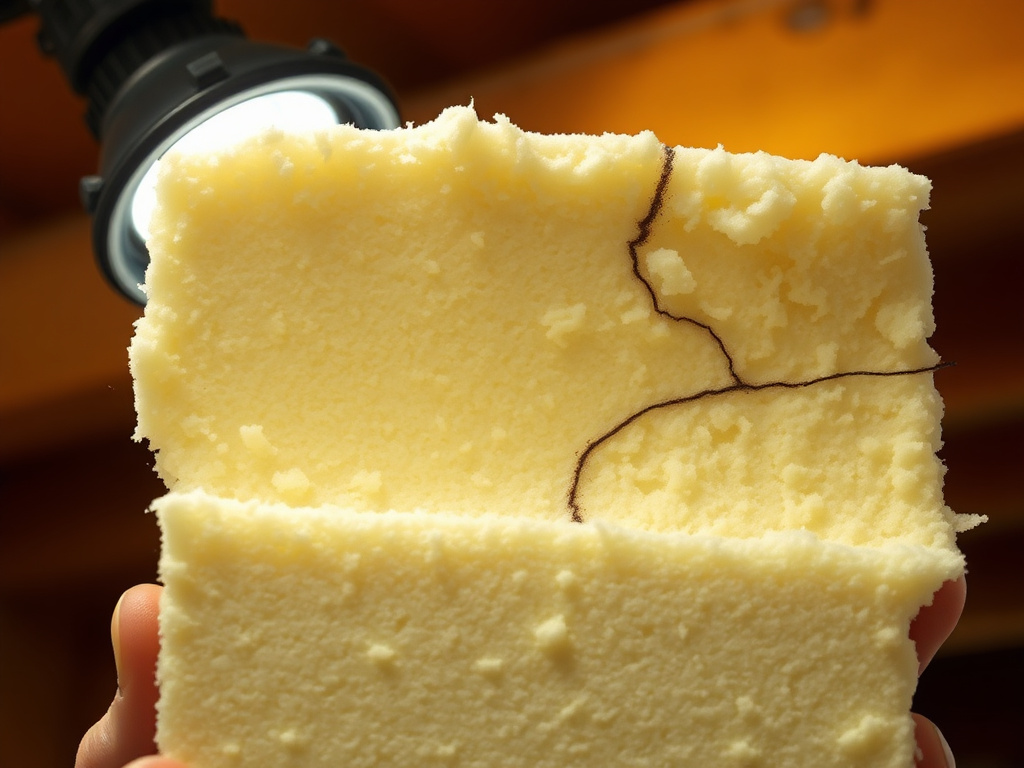
Too much A-side commonly produces foam that's brittle, crumbly, and shrunken, sometimes with a fishy or sharp chemical odor from unreacted amine catalyst. Too much B-side tends to produce foam that stays soft, spongy, or tacky and never fully firms up. Because the reaction happens in seconds at the gun tip, off-ratio defects are frequently localized to specific passes rather than an entire job — a cold morning start, a spot where the applicator paused, a brief cavitation event.
- Brittle, crumbly, shrunken texture — commonly excess A-side
- Soft, spongy, never-cures texture — commonly excess B-side
- Often patchy rather than sitewide, tied to transient equipment or temperature conditions
Adhesion Failure
Foam can cure correctly and still fail to do its job, if it never properly bonded to the substrate. Dust, dirt, oils, form-release agents on concrete, or an incompatible existing coating can create a contamination layer between the substrate and the foam — the foam ends up bonded to the contaminant, not the framing or sheathing underneath it.
Adhesion failures aren't always visible from the surface. A section of foam can look and feel normal while being only weakly attached, which is why a forensic assessment often includes probing or targeted removal at representative locations rather than relying on a visual inspection alone.
- Substrate contamination is the leading cause — dust, oils, release agents, incompatible coatings
- Not always visible without probing or targeted removal
- Foam is present and may look normal, but isn't structurally bonded
Moisture Entrapment
Two distinct moisture mechanisms show up in SPF forensic work. The first is foam applied over a substrate that was too wet at the time of spraying — commonly cited around 19% moisture content or higher — which can produce poor cell structure and, as the framing subsequently dries and shrinks, separation between the foam and the substrate.
The second is moisture that becomes trapped behind an otherwise correctly cured SPF layer, most often in roof or wall assemblies where the vapor-control strategy didn't account for the actual moisture drive at that location and climate zone. This mechanism can be entirely independent of how well the foam itself was mixed and applied — it's a design or assembly-level issue that surfaces as apparent 'foam failure' even though the foam performed as installed.
- Wet-substrate application: poor cell structure, later separation as framing dries
- Trapped moisture behind a correctly cured foam layer: often a design/assembly issue, not an installation defect
- Distinguishing the two is central to assigning the right remediation scope
Insufficient Thickness for the Assembly's R-Value Target
A less dramatic but common finding: foam that cured correctly and bonded well, but simply wasn't applied to the specified or code-required thickness. This can result from an applicator misjudging lift thickness, a spec that didn't clearly communicate the target thickness for the assembly, or field conditions that made hitting the full spec impractical without a design change that was never made.
Under-thickness doesn't always produce an obvious visual symptom — it typically shows up as a performance gap (a higher-than-expected energy bill, a comfort complaint, or a failed blower-door or thermal-imaging test) rather than a visible defect, which is part of why it can go undiagnosed without a targeted investigation.
Putting It Together: Why the Distinction Drives the Remediation Plan
An off-ratio defect in one attic bay calls for spot removal and reinstallation of that section. A sitewide adhesion failure from a contaminated substrate calls for a broader removal and a substrate-preparation fix before reinstallation. Trapped moisture from a design-level vapor-strategy problem calls for an assembly redesign, not just a foam swap — and may implicate the specification rather than the installer.
That's the practical reason a forensic investigation is structured around identifying the mechanism, not just documenting that a problem exists: the mechanism determines the scope, the cost, and often which party is responsible for it.
Related reading
Frequently asked questions
Yes — it's common. A humid job site can contribute to both off-ratio chemistry (moisture reacting with the A-side) and adhesion problems (a damp substrate), which is why a forensic assessment looks at the whole picture rather than confirming the first plausible cause and stopping.
Installation defects (off-ratio mixing, adhesion failure from a dirty substrate, wet-substrate application) trace to what happened during spraying. Design defects (a vapor strategy that doesn't fit the climate zone, an under-specified thickness) trace to the assembly on paper, independent of how well it was executed. A forensic review checks both the installed condition and the original specification.
Not necessarily — it depends on whether the moisture source has been addressed and whether the foam itself sustained damage. That's part of what a forensic assessment determines before a remediation scope is set.
Have a project that needs an engineering opinion?
Tell us about the project and we'll scope a consultation.